Why Your Waterpik Water Flosser Fails Early (And What Skipped Maintenance Actually Costs)
-
Last Month, Our Waterpik Water Flosser in Room 3 Stopped Charging
-
The Surface Problem: Dead Units
-
Deeper Cause 1: Nobody Cleans a Water Flosser Until It Fails
-
Deeper Cause 2: The Charger Is Not Always the Charger
-
What Skipping Maintenance Actually Costs: A Real TCO View
-
The Same Root Cause Shows Up in Other Equipment
-
The Short Version: What We Do Now
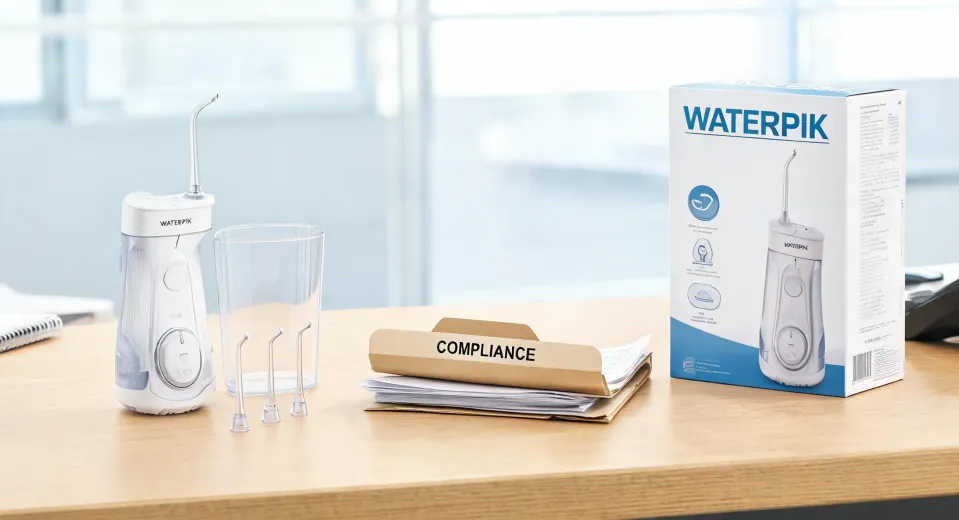
Last Month, Our Waterpik Water Flosser in Room 3 Stopped Charging
That does not sound dramatic. But it was 11:40 on a Tuesday, the room was full, and the hygienist had to walk across the building to borrow a corded unit from another room. Within a week, two more Waterpik units slowed down or refused to charge.
I manage procurement for a six-location dental group. We run 22 Waterpik water flossers across patient rooms and checkup areas. I have tracked every repair, replacement, and lost-time event in our cost system for five years. So when three units failed in seven days, my first thought was not bad luck. My first thought was, what did we skip?
The answer: cleaning, charger compatibility, and a few other boring things that are a lot cheaper to fix than replacements.
The Surface Problem: Dead Units
From the outside, the problem looks obvious. The unit won't charge. The motor sounds weak. The pressure is uneven. The sticker price of a replacement is maybe $70 to $100. In a busy clinic, replacing a dead unit often feels faster than fixing it.
But here's the thing I have learned the hard way: the unit is not the problem. The accumulated stuff is.
Surface issue: broken device. Actual issue: skipped maintenance, wrong charger, and a procurement system that rewarded cheap up-front cost over total ownership cost.
Deeper Cause 1: Nobody Cleans a Water Flosser Until It Fails
The phrase how to clean the Waterpik water flosser is one of the most useful searches on this topic. But the answer only helps if you treat it as a schedule, not a rescue mission.
Mineral deposits from hard water, biofilm, and leftover mouthwash can build up inside the reservoir, valves, and piston area. That buildup makes the motor work harder. Pressure drops. The unit sounds louder. Eventually the motor draws more current than it should, and the battery or pump gives up.
Waterpik's official care instructions (waterpik.com, accessed April 2025) include model-specific cleaning and descaling steps. For many models, a mixture of two parts water to one part white vinegar is the standard descaling routine for the reservoir. It's a fairly simple task. It's also a task that gets pushed aside when the schedule is full.
To be fair, our staff wasn't being lazy. They were being efficient in the short term. Cleaning a reservoir takes 10 minutes. Seeing another patient takes priority. But skipping that 10 minutes created a $200 problem later.
Deeper Cause 2: The Charger Is Not Always the Charger
If you search for a Waterpik water flosser charger, you will see multiple models and shapes. They are not all interchangeable. Some units require specific chargers or charging bases, and using one that kind of fits can undercharge or overcharge the battery.
Our cost tracking showed that two of the three failed units had been charged with random chargers from a drawer. The LED glowed, so nobody questioned it. But the battery never reached full capacity. Over weeks, the battery degraded. The units then failed during a patient appointment.
We were somewhat skeptical at first. The numbers said replace the dead units and move on. My gut said something else. When I sorted the failures by room and charger log, the pattern was clear: the units that failed were the ones that had been charged with mismatched chargers.
I still kick myself for not fixing this sooner. If I had labeled chargers, thrown out incompatible ones, and documented which model sat in each room, we would have saved at least two units and the staff time to deal with them.
What Skipping Maintenance Actually Costs: A Real TCO View
The cheapest unit is not always the least expensive unit. This is where total cost thinking matters.
A single Waterpik unit is not a huge capital expense. But unscheduled failures cost more than the replacement price. When I audited our 2023 spending, I found that rush replacements and emergency troubleshooting accounted for roughly 18% of our oral care equipment budget. Most of that was not the unit itself. It was the time spent reacting.
For one failed unit in our practice, the total cost included:
- The replacement unit, about $80 to $100 depending on the model.
- 20 to 30 minutes of an assistant's time to swap, charge, and test it.
- Room downtime during a busy schedule.
- The disruption when a hygienist needs to grab a spare unit from another room.
- The uncertainty of whether the backup unit is charged.
I won't pretend this added up to thousands per unit. It was usually somewhere around $200 in our internal tracking. But with two or three failures per year, that is real money. And none of it shows up on the invoice from the replacement.
Replacement cost + staff time + downtime + patient disruption = total cost. If you ignore the last three, you are not managing a budget.
The Same Root Cause Shows Up in Other Equipment
Once you start thinking this way, you see the same pattern in other equipment.
The NutriBullet Pro 900 personal blender in the staff lounge stopped spinning last year. The motor was fine. The threaded base had residue on the safety interlock, so the machine refused to run. The cheap fix was cleaning the threads. The expensive fix would have been a new blender.
People ask, how does a lock washer work? The useful answer is not just that it locks. It works by creating tension between a fastener and the surface. If the surface is dirty, the washer is wrong, or the torque is off, it does not lock. Small details create big outcomes.
And then there was the Richmond tankless water heater code 12. When our maintenance manager sent me a photo of the display, my first instinct was to call a service company. The technician asked when we had last flushed the unit. We had not. The code was not the root problem. It was the result of skipped maintenance. Once we flushed the system, the error cleared.
I am not going to recite the exact meaning of Richmond tankless water heater code 12 for every model, because the manual matters. But the pattern was identical: we almost spent money on a replacement before checking the thing that was actually clogged, dirty, or misaligned.
The Short Version: What We Do Now
The solution is not dramatic.
- We put cleaning dates on the room schedules. Every Waterpik unit gets a descaling and cleaning check on a regular rotation.
- We standardized chargers. Each unit stays with its own charger, and incompatible chargers are gone.
- We use Waterpik's official instructions for cleaning, and we verify model-specific steps before doing anything.
- When I compare vendors, I compare total cost over 36 months, not sticker price.
I'm not going to tell you that a water flosser replaces flossing or professional dental cleanings. That is not true, and that is not the point. The point is that equipment fails when maintenance is treated as optional. The same thinking applies to a Richmond tankless water heater code 12, a NutriBullet Pro 900 personal blender, or a lock washer: understand how the thing works, and you will know what to clean, what to check, and what to replace.
Why does this matter? Because the broken unit is usually a symptom. The real problem is the skipped step that happened weeks before.
That is the part that never shows up on the invoice. And it is the part a cost-controlled, well-run operation can fix before the next unit dies.

Greta Lindholm
Greta Lindholm is a household refrigeration analyst covering French-door, side-by-side, top- and bottom-mount refrigerators, mini fridges, beverage coolers, chest freezers, and upright freezers. She applies IEC 62552 and IEC 60335-2-24 while comparing energy consumption, usable volume, pull-down time, compartment temperature stability, freezing capacity, noise, door-seal leakage, refrigerant charge, and ambient-temperature performance. Her guides help importers, distributors, private-label teams, and appliance engineers select platforms around climate class, storage mix, efficiency labels, cabinet dimensions, service access, shipping density, and warranty exposure.